Wellness practitioner dashboard: 7 KPIs worth tracking
By the Welbeo editorial team · Editorial policy

A useful dashboard for an independent wellness practitioner does not need twenty graphs. Five to seven consistently measured indicators can tell you whether your schedule is filling up, whether clients return, and whether your practice is financially sustainable.
For a yoga teacher, therapist, massage practitioner or naturopath, the best dashboard connects numbers to decisions. You should be able to look at it once a week and answer: What should I change next?
At a glance
- Track a small set of key performance indicators (KPIs), not every number available.
- Start with booking occupancy, average revenue per appointment, repeat visits, collected revenue, new clients, feedback and cancellations.
- Compare results with your own historical figures; industry averages rarely tell the whole story.
- Distinguish appointments scheduled from money actually collected.
- Use aggregate data where possible to protect client privacy.
Why does a solo practitioner need a dashboard?
When you manage your own practice, you are often responsible for scheduling, client communication, visibility and finances. It is easy to run on intuition: one fully booked afternoon feels like a successful month, while a quiet Monday can create unnecessary worry.
A simple dashboard gives you perspective. It shows the difference between a temporary variation and a pattern worth investigating.
Bpifrance Création's management-dashboard guidance describes dashboards as a way to summarize activity, anticipate difficulties and compare results with goals. For an independent practice, that translates into three questions:
- Are enough appointment slots being booked to meet my needs?
- Do clients return when continued appointments are appropriate?
- Which sources of discovery lead to actual enquiries or first bookings?
Not every professional should optimize repeat visits. For time-limited therapeutic support, completing an agreed course of care may be a better measure than encouraging unnecessary appointments.
Seven useful KPIs for wellness practices
| Indicator | What it measures | Practical calculation |
|---|---|---|
| Booking occupancy | Share of bookable time that is reserved | Booked hours ÷ available bookable hours |
| Average appointment value | Revenue per completed appointment | Relevant revenue ÷ completed paid appointments |
| Return rate | Proportion of clients coming back within a defined period | Returning clients ÷ eligible clients in that period |
| Revenue | Money earned and collected | Separately track invoices, collections and future bookings |
| New clients and source | Where first-time clients find you | Count first bookings by reported discovery channel |
| Reviews and feedback | Voluntary public feedback | Number of new authentic reviews, alongside context |
| Cancellation and no-show rate | Reserved time that goes unused | Cancelled/no-show appointments ÷ relevant booked appointments |
Choose consistent definitions. For example, whether a late cancellation counts against occupancy depends on whether the slot can be resold. Write down the rule so your comparisons remain meaningful.
1. Occupancy rate: understand available time
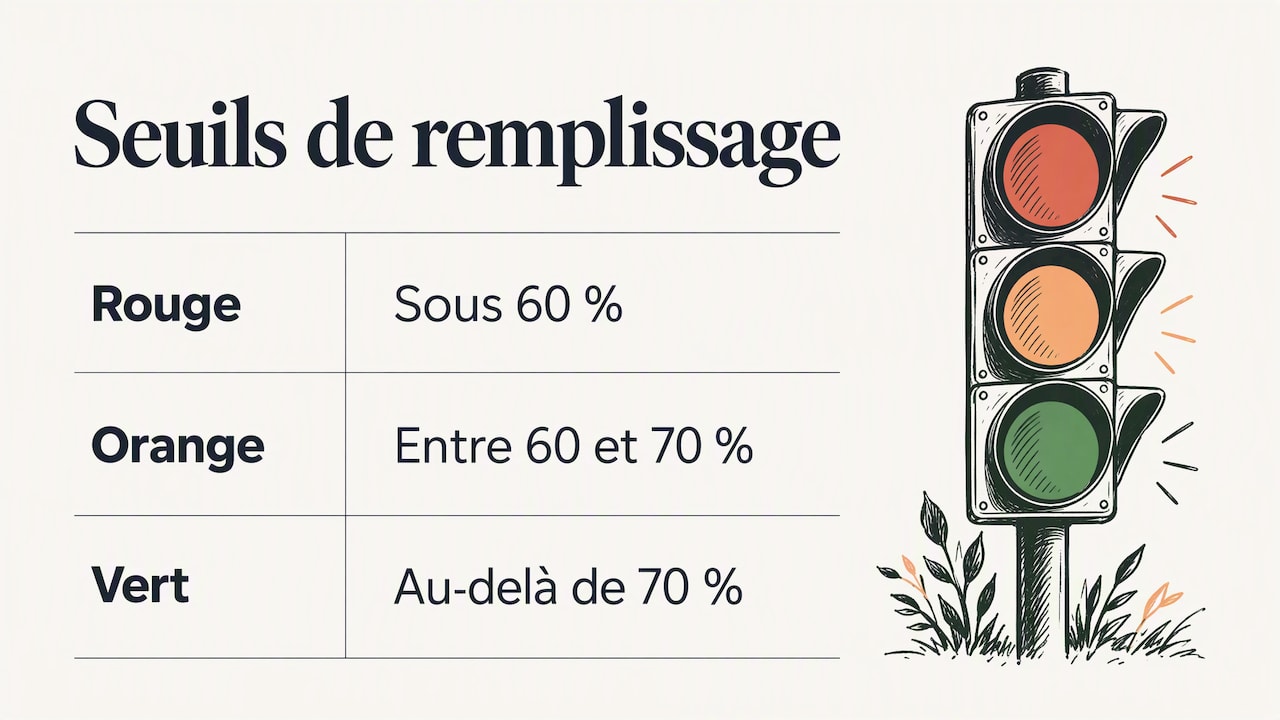
Imagine you offer 20 hours of bookable appointments each week and 13 hours are reserved. Your occupancy rate is 65%.
That number alone is not a verdict. Look at where gaps occur. Perhaps evenings are consistently full while Tuesday mornings have little demand. You could test different opening hours, improve descriptions for certain services or announce available slots through channels your clients actually use.
Avoid applying generic red/amber/green thresholds to every profession. A practitioner doing longer consultations might have different ideal utilization than a studio offering group classes.
2. Average appointment value: know what each booking contributes
If completed appointments produce €900 in earned revenue across 15 sessions, the average appointment value is €60.
But revenue is not profit. Include direct expenses, payment processing and professional time when deciding which services are sustainable.
For group lessons, you may prefer revenue per class and revenue per participant. For packaged appointments, allocate payments consistently instead of counting the full package value at every session.
3. Repeat visits: measure relationships responsibly
Track how many eligible clients return within a useful window, such as 90 days. Interpret this figure in the context of your service.
A repeat massage client or a regular yoga student may be an appropriate long-term relationship. A therapist whose client completes a planned program should not necessarily view a lack of repeat bookings as failure.
Measure completion of intended care or class attendance when that makes more sense than retention.
4. Revenue: separate earned, collected and expected amounts
An appointment scheduled for next month is not cash received today. A good dashboard distinguishes completed services, issued invoices, paid amounts and scheduled future appointments.
For financial and tax decisions, rely on your accounting system and adviser rather than treating a calendar total as a financial statement.
5. New clients: discover what is working
For first bookings, ask a short optional question: How did you hear about us? Possible answers include Google, your website, a recommendation, social media, a local event or a booking marketplace.
Over several months, patterns may emerge. Still, treat these as self-reported sources, not definitive multi-touch marketing attribution.
Google Search Console, where connected to a verified website, provides search clicks and impressions. It does not independently tell you how many website visitors booked a session.
6. Reviews: watch trust, not just star counts
Public reviews can help people feel informed, but they are sensitive in health-adjacent services. Never pressure clients to disclose a relationship publicly, incentivize positive feedback or reveal private consultation details in your response.
Track authentic feedback and whether your public business details remain clear and current. A review count is a signal, not a complete measure of professional quality.
7. Cancellations and no-shows: spot avoidable gaps
Compare late cancellations and no-shows with the bookings made during the same measurement period. Consider whether reminders, clear cancellation policies or a waitlist might help.
Some cancellations are unavoidable. Focus on overall scheduling patterns rather than blaming clients.
Choose metrics based on your current business goal
| Your situation | Main objective | Start with |
|---|---|---|
| Newly established practice | Be discoverable and win first bookings | New clients, discovery source, enquiries, occupancy |
| Uneven appointment calendar | Fill relevant gaps | Occupancy by time slot, cancellations, availability |
| Established client base | Improve financial sustainability | Revenue, average appointment value, direct costs |
| Classes and workshops | Fill group sessions | Sign-ups, capacity utilization, repeat attendance |
Review your choices every quarter. If a number never informs a decision, it probably does not belong in your weekly overview.
Worked example: a massage practitioner's week
Consider a fictional massage practitioner who offers 20 bookable hours per week. Thirteen hours are booked: occupancy is 65%.
A closer look shows that evenings are generally full, but some daytime slots are empty. She chooses one practical experiment: rewrite the description of a lunchtime massage appointment and make that slot easier to find on her booking page.
She also records ten first-time clients during the month. Six say they found her through an online search, three heard about her from someone else, and one found her at an event. These are reported discovery channels, not a claim of precise campaign attribution.
After four weeks, she reviews occupancy and enquiry quality. If the change helped, she may keep it; otherwise, she tests another adjustment.
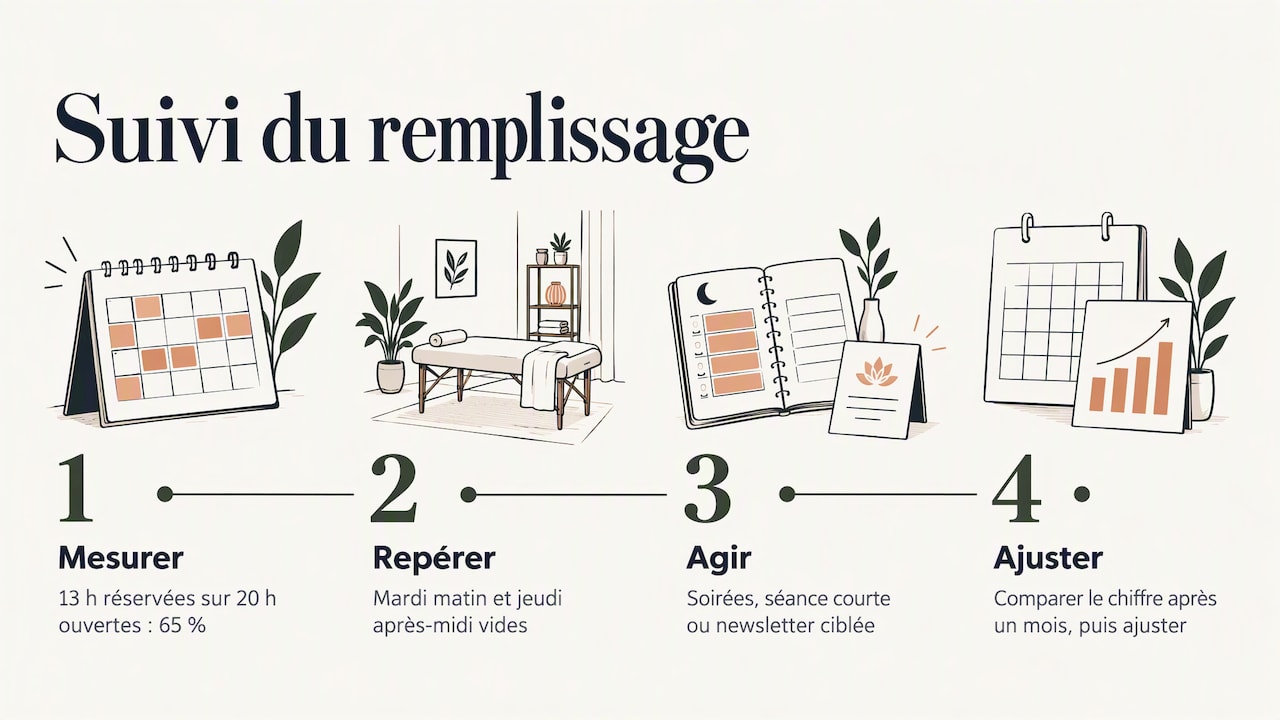
That is the main benefit of a dashboard: one decision, one measured experiment, and a regular review.
Create a simple weekly dashboard in four steps
- Set a goal. For example, “fill two additional weekday appointments per week” or “reduce missed bookings.”
- Pick five to seven indicators. Define exactly what each includes and excludes.
- Reserve fifteen minutes each week. Measure on the same day, and compare comparable time windows.
- Record one next action. Note what you changed and when to assess the result.
A spreadsheet is entirely adequate to begin. Complexity becomes useful only when it saves meaningful work or improves decisions.
Spreadsheet or dedicated practice software?
A simple spreadsheet gives you control over the calculations and costs little or nothing. It may be ideal if you have a small number of appointments and want to understand how each indicator works.
Practice-management software becomes more useful when bookings, availability, payments and client communications already occur in one system. The value comes from reducing duplicate entries and making important patterns easier to find.
Ask a vendor which metrics are genuinely measured, how missing information is shown, whether past trends are preserved, and whether a figure represents bookings, visitors or paid revenue.
Don't assume a “visibility score” is the same as actual website traffic.
Client data and GDPR
Even a small practice may process personal data in appointment and client records. When dealing with sensitive information, avoid putting client identities or health notes into analytics spreadsheets unless strictly necessary.
The French data protection authority offers guidance on GDPR and independent healthcare professionals. The precise legal obligations depend on your activity and the kinds of information processed.
For dashboards, use aggregates whenever possible. Give access only to people who need it, retain information for an appropriate period, and review providers' security and data-protection terms.
Real practitioner websites: examples of clear online presentation
A dashboard cannot improve a website by itself, but clear service descriptions, practical information and easy booking paths can make visibility more useful.
For independently branded websites associated with Welbeo practitioners, you can explore:
- Minsana Massage in Rueil-Malmaison — an example of a local massage practice website.
- Stéphanie Avédissian — professional information for naturopathy services.
- Carole Pariat — an example of how a hypnosis practice introduces its services.
- Laure Manlot — another practitioner website with its own professional presentation.
These references illustrate different website approaches. They are not testimonials or claims about the practitioners' revenues, KPIs, marketing methods or business results.
How Welbeo helps practitioners monitor visibility and bookings
Welbeo brings together practitioner presentation and online booking, with tools to work on discoverability and business growth. Its Growth Hub includes a digital presence readiness score, reflecting factors such as website and profile quality. That score is not a count of visitors or a Google ranking.
Where Google Search Console is connected and data is available, practitioners can review actual search clicks, impressions, click-through rate and average search position. Booking metrics are measured separately; a Google click is not automatically a booking.
The Welbeo professional platform and pricing overview explain the current features and plans. Check the current offering before choosing a plan.
Frequently asked questions
What does a dashboard do for a solo practitioner?
It summarizes a few relevant indicators so you can spot trends, compare results with goals and decide on practical actions. It helps you make consistent decisions instead of reacting to one unusually busy or quiet day.
How many KPIs should I track?
Five to seven is a useful starting point. A smaller set that you understand and review is more valuable than a large dashboard you rarely use.
Which KPI matters most for an independent wellness practice?
It depends on the goal. Occupancy is useful when your calendar is underfilled, but revenue and contribution margin matter when evaluating sustainability. For new practices, first bookings and discovery sources may matter most.
Is a booking equivalent to a new client?
No. A booking may be from an existing client, and one client may make several bookings. Count first-time customers separately.
Can Google Search Console tell me how many clients booked?
Not on its own. Search Console reports search performance, while booking data comes from your reservation system. Attributing bookings to a particular source requires an appropriate measurement setup.
Can I start with a spreadsheet?
Absolutely. Use a simple weekly table, record definitions for each metric and review your results consistently. Move to dedicated software when it will clearly reduce manual work.
Sources and further reading
- Bpifrance Création — Management dashboards
- Bpifrance Création — Your commercial action plan
- CNIL — GDPR and independent healthcare professionals
Editorial examples are illustrative, not actual practitioner performance data.