Customer acquisition cost (CAC) for wellness practitioners: how to calculate and reduce it
By the Welbeo editorial team · Editorial policy

Customer acquisition cost (CAC) tells you how much your practice spends to win one new client. The formula is straightforward: acquisition spending ÷ new clients acquired during the same period.
The challenge is choosing the right spending, counting genuinely new clients, and interpreting the number without forgetting the time you spend on marketing. For an independent massage therapist, naturopath or yoga teacher, a useful CAC calculation can be much simpler than the dashboards built for software companies.
In short
- Calculate overall CAC and paid-ad CAC separately.
- Track real new customers, not page views or enquiries alone.
- Compare acquisition cost with the margin a customer generates, not simply the booking price.
- Keep your method consistent from month to month.
- Work on your service pages, booking journey and referrals before increasing advertising spend.
What is the difference between overall CAC and paid CAC?
Overall CAC, sometimes called blended CAC, covers all your customer acquisition activities: advertising, promotional content, a relevant share of website costs, marketing tools, and time spent attracting new business.
Paid CAC looks specifically at advertising spending divided by new customers attributable to those campaigns.
Consider a purely illustrative month in which your practice spends €240 in total on acquisition and welcomes 12 new clients. Your overall CAC is €20. If €100 of that budget was advertising and it brought in four of those clients, your paid CAC is €25.
The distinction is useful. The overall figure helps you understand the economics of growing your practice; the paid figure helps you decide whether a particular campaign deserves more money.
For a broader explanation, see the Ahrefs guide to customer acquisition cost.
Which costs belong in the calculation?
A practical rule is to count spending that serves the purpose of attracting new customers. Depending on how your practice operates, this can include:
- Paid search and social media advertising.
- Flyers, events and introductory promotions.
- Marketing freelancers or agencies.
- Website pages and content created to attract new clients.
- Marketing software subscriptions, including an appropriately allocated share of general-purpose tools.
- The value of your time spent on acquisition, if you want an economic rather than a cash-only view.
Do not automatically include the cost of delivering sessions, ongoing customer care, product development or unrelated business overhead. If a tool serves acquisition and day-to-day operations, choose a reasonable allocation and apply it consistently.
A note on time: many solo practitioners manage marketing themselves. If you leave your time out, call the result your cash CAC rather than assuming promotion was free. A simple timesheet can make the picture more realistic.
How should you measure CAC by channel?
One blended number can hide important differences. If you can, record where each new customer first discovered you: Google Search, Google Business Profile, your own website, Instagram, a referral, a marketplace or an event.
A small table is enough to start:
| Channel | Acquisition spending | New customers | CAC |
|---|---|---|---|
| Local advertising | €120 | 4 | €30 |
| Community event | €80 | 5 | €16 |
| Total in this example | €200 | 9 | €22.22 |
These are fictional numbers, not industry averages. In reality, a client may see an Instagram post, find your website a week later and book after a recommendation. Decide how you will attribute that journey and be transparent about the uncertainty.
If bookings are sparse, compare two- or three-month periods rather than judging one unusually quiet week.
CAC, customer lifetime value and payback
CAC becomes more meaningful when you compare it with what a client contributes over time.
Customer lifetime value (LTV) estimates the value of an ongoing customer relationship. For a small wellness practice, it is often more useful to think in terms of contribution margin after the direct cost of delivering appointments, rather than gross revenue.
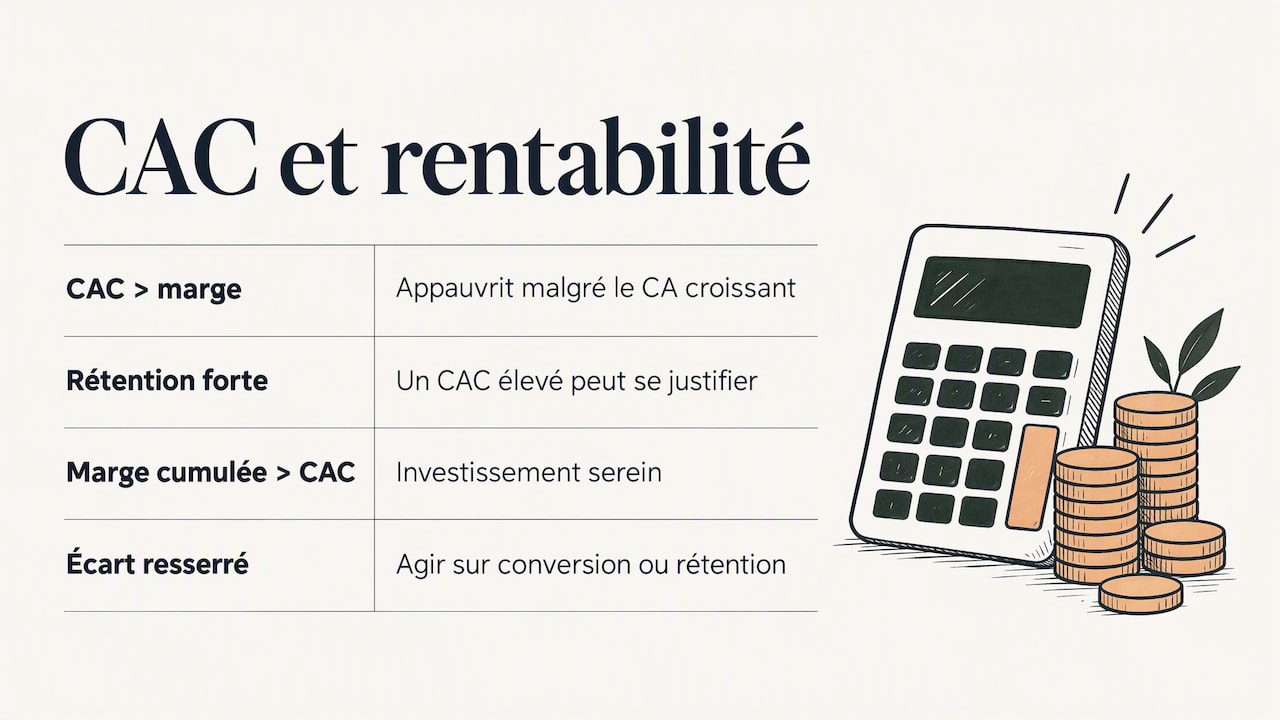
Imagine a new client books an €80 session, with €25 in direct costs. The appointment contributes €55 before other fixed expenses. If acquiring that client cost €20, the first visit may cover acquisition cost. If the same client returns several times, the economics change again.
A commonly quoted 3:1 LTV-to-CAC ratio comes from discussions about subscription businesses. It is not a universal standard for a yoga teacher, massage practitioner or therapist. Pricing, frequency of sessions and professional responsibilities make each practice different.
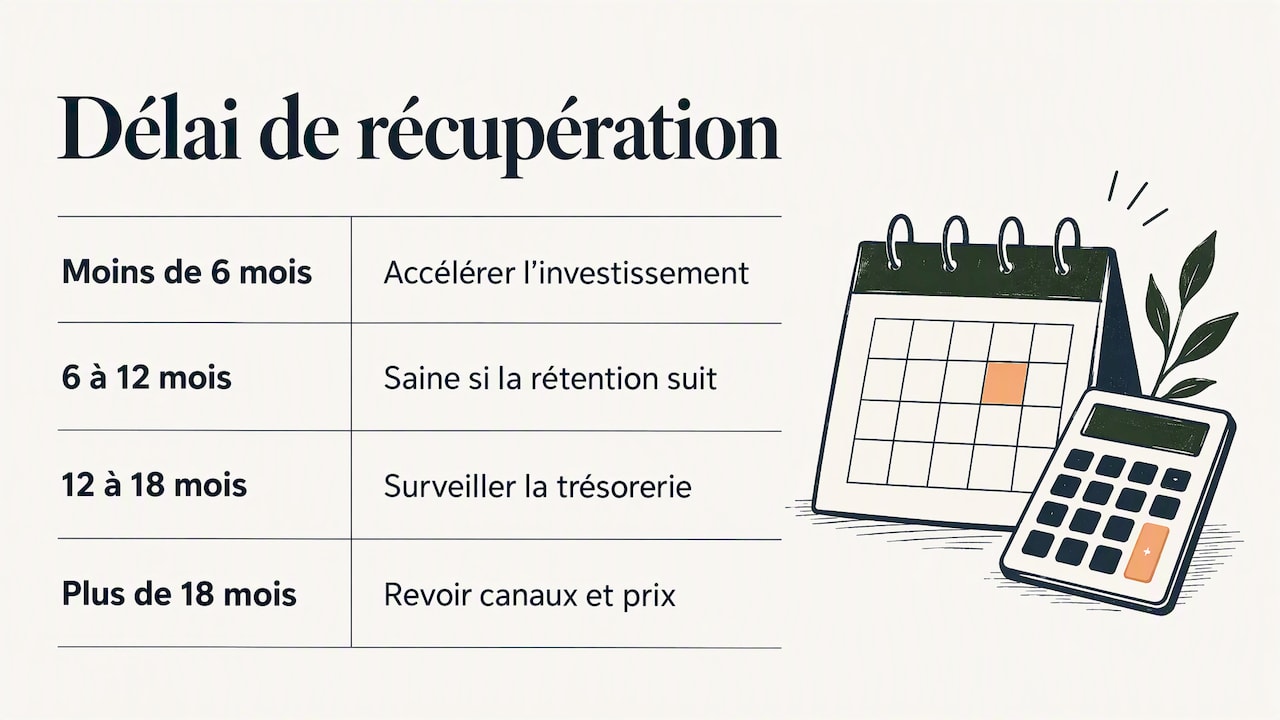
Similarly, payback period measures how long it takes the margin produced by a customer to recover their acquisition cost. Calculate it using your actual appointment economics; avoid applying SaaS payback thresholds mechanically to personal services.
How can a wellness practitioner lower CAC?
1. Improve the journey from discovery to booking
Clear descriptions matter. Does your website tell visitors exactly what happens during a first appointment, how long it takes, what it costs and where you are located? Can someone book from a phone without sending several messages?
A more straightforward booking journey can improve conversion without increasing advertising spend.
2. Make local visibility work harder
Keep your Google Business Profile accurate if your practice is eligible for one. Use descriptive service pages and clear location information on your site. Helpful articles can answer client questions before someone makes contact.
Local search improvements take time; they should be evaluated over months, not promised as overnight results.
3. Encourage genuine recommendations
Make it easy for satisfied customers to share your public business details if they choose to. Never pressure clients into public reviews, offer incentives for positive reviews or disclose confidential relationships.
Bpifrance Création's customer retention guidance provides wider context on why maintaining existing relationships matters.
4. Test small changes
Try a clearer service title, a simpler booking button or a revised local advertisement. Change one thing at a time, monitor results, and avoid spending large amounts before you have enough observations.
5. Treat retention separately
A returning client does not retroactively become a new acquisition. Retention improves the value of your original acquisition spending, but it should be measured separately rather than mixed into the CAC denominator.
What else should you track alongside CAC?
CAC alone cannot tell you whether marketing is helping your practice. A compact monthly dashboard might include:
- Visits to relevant service pages.
- Enquiries and completed reservations.
- Conversion rate from enquiry to booked first appointment.
- Number of first-time customers by channel.
- Returning-customer rate.
- Contribution margin per session and estimated LTV.
- Direct advertising spending and time spent on marketing.
Choose metrics you can genuinely collect. Perfect attribution is usually less useful than a consistently maintained record.
Do AI tools help reduce customer acquisition cost?
They may help create first drafts of articles, organize marketing ideas or identify confusing service descriptions. But AI tools are not free to operate: count subscriptions, editing time and supervision as part of the work.
Practitioners should review everything before publishing. In health-adjacent services, avoid fabricated credentials, misleading outcome claims or promotional messages that pressure vulnerable people.
Use AI to reduce repetitive work, not to replace professional judgment.
Why CAC affects the profitability of your practice
A booking can increase revenue while contributing very little profit. If the total cost of acquiring a customer exceeds the margin that customer generates across their relationship with you, the strategy is not sustainable.
Consider the number of sessions you have available, too. If you're already fully booked on Tuesdays, paying to attract more Tuesday clients may not be useful. Better availability information or an alternative class format could be more valuable.
This is why the cheapest channel is not always the best one. A thoughtful referral may produce a long-lasting relationship even when the initial acquisition cost is slightly higher than a discounted offer.
Are industry CAC benchmarks reliable?
Be cautious. A widely shared figure from online retail or SaaS can be inappropriate for an independent wellness practitioner in France. Geography, session prices, frequency of return, capacity and the difference between a one-off appointment and a package all matter.
Your own historical data is usually the most meaningful benchmark. Compare like with like: the same expenses, same attribution method and equivalent time periods.
If you don't have enough new customers to calculate a stable monthly CAC, use a longer observation period and label your estimates clearly.
Real-world types of practice, without invented marketing results
Different wellness businesses need different routes to discovery.
A massage business might focus on local searches and clear descriptions of its treatments. For an example of how a professional massage website can present services, explore Minsana Massage in Rueil-Malmaison.
Someone looking for naturopathy support may want to understand a practitioner's approach, practical information and first-session arrangements. Stéphanie Avédissian's website illustrates this type of professional presentation.
A hypnosis practice may benefit from reassuring information and clearly explained appointments. You can see an example on Carole Pariat's website.
And for an independent professional arranging recurring sessions, a clear website can help visitors understand the services offered. Laure Manlot's website provides another illustration.
These links are examples of independently branded practitioner websites maintained through Welbeo. They do not indicate the practitioners' actual acquisition costs, marketing results or endorsement of any specific strategy.
A simple monthly CAC routine
Start with just four steps:
- Gather the marketing expenses you can identify, and decide whether to add an estimated value for your time.
- Count first-time clients during the same measurement period; distinguish them from repeat bookings.
- Calculate overall CAC and, if relevant, the CAC of each advertising channel.
- Compare the result with contribution margin and client retention, then pick one improvement for the next month.
Repeat the process consistently. You do not need complicated attribution software to begin making better decisions.
How Welbeo can support your visibility
A clear online presence and an easy reservation process can help people go from discovering your practice to understanding its services and booking an appointment.
Welbeo brings together practitioner presentation, online reservations and visibility tools. Explore the professional offering or current plans, and decide which features address your actual needs. Software itself does not guarantee lower acquisition costs.
Frequently asked questions
How do you calculate customer acquisition cost?
Divide total new-customer acquisition spending by the number of new customers gained over the same period. Use a consistent method for both figures.
Should I include the cost of my website?
Include an appropriate portion of website costs if the site is used to attract new customers. If it also serves existing clients, make a consistent and reasonable allocation.
Is a €20 CAC good for a massage practitioner?
There is no universal answer. Compare that €20 with your margin on a first booking, the likelihood of repeat visits, your capacity and alternative channels. The number only makes sense in context.
How can I reduce CAC without buying more advertising?
Improve service-page clarity, local search information, booking usability and genuine referrals. Measure whether those changes help bring in new customers over time.
Is CAC the same as cost per lead?
No. Cost per lead counts enquiries; CAC counts customers who actually make a first purchase or booking. Several enquiries may be needed to acquire one customer.
Further reading
- Ahrefs: Customer acquisition cost
- Amazon Ads: Customer acquisition
- Bpifrance Création: Customer retention
Editorial note: figures in the examples are illustrative and should not be interpreted as benchmarks for a particular profession. Reviewed by Welbeo for independent wellness practitioners.