Yoga SEO: how to help new students discover your classes
By the Welbeo editorial team · Editorial policy
Yoga SEO: how to help new students discover your classes
A yoga teacher or studio doesn't need to rank for the word “yoga” everywhere. The more useful goal is to be found when somebody searches for a particular style, level, timetable or place—and to make it easy for that person to understand and book a class.
For an independent instructor, start with clear class pages, accurate local information, helpful answers to student questions, and a booking journey that works on mobile. None of these steps guarantees a Google ranking, but they can make a practice easier to discover and understand.
The essentials
- Explain each genuine class offering: style, level, format, location, duration, price and booking options.
- Use phrases students might search, such as “beginner hatha yoga in Rueil-Malmaison”, rather than repeating “yoga” unnaturally.
- Keep your contact details and opening times consistent.
- Create or maintain a Google Business Profile only if the practice is eligible under Google's rules.
- Treat reviews and newsletters with care for consent and personal data.
- Monitor Search Console impressions and clicks separately from reservations.
Why search visibility matters for yoga classes
People searching for “yoga” may only be exploring. People searching for “evening beginner yoga near me” have a more specific intention. A useful website should answer that practical need.
France's Insee survey of physical and sporting activity provides background on yoga participation in 2020, but national statistics do not establish demand for an individual studio today. Validate your actual local audience through enquiries, trial classes and searches.
Understand prospective students' questions
A student may want to discover what vinyasa means, compare yin and hatha yoga, verify a venue, or reserve a class. Each question deserves an appropriate destination.
A beginner's guide is different from a timetable. A booking page is different from a teacher biography. Your navigation should help students move naturally between them.
Select useful yoga keywords
Start with four practical dimensions:
| Dimension | Examples |
|---|---|
| Style | Hatha, vinyasa, yin, gentle yoga |
| Experience | Beginner, intermediate, small group |
| Location | Actual city, neighborhood, venue or online |
| Format | Group class, private lesson, workshop |
Listen to the language students use. Check Google suggestions for ideas, not as proof of search volume. Look at nearby studios to understand the information people expect, without copying their pages.
Put relevant terms naturally in the page title, visible heading, introductory copy and image alt text. Avoid mass-producing city pages where you do not actually teach.
Organize a website around real classes
| Page | Main purpose | Essential information |
|---|---|---|
| Home | Introduction | Teaching style, area, class types |
| Class page | Compare and decide | Level, venue, schedule, duration, price |
| Private sessions | Understand the format | Who it suits, location and booking |
| Workshops | Discover an event | Dates, agenda and number of places |
| About | Build trust | Training, experience, teaching approach |
| Contact and location | Plan a visit | Actual venue, transport, contact |
| Articles | Learn | Helpful explanations linked to relevant classes |
A new page is worthwhile when it provides genuinely distinct information. One thin page per neighboring city is not a sensible SEO strategy.
Make each class page useful
A page for beginner hatha yoga could explain the pace of the session, what to bring, how many places are available, the cost and where to arrive. Give students one clear next step, such as “Book a trial class.”
Local SEO for in-person yoga teaching
An eligible yoga studio or in-person teacher may use a Google Business Profile to describe their real business. The location and service-area rules matter: online-only operations without face-to-face customer contact generally are not eligible, and an occasional rented venue may not qualify as a permanently staffed business address.
Keep your public business name, real address when appropriate, contact details, booking URL and published hours accurate. Respond to reviews professionally without revealing private client information.
Google documents Organization structured data and LocalBusiness markup; accurate markup can help clarify your visible details but cannot promise higher rankings.
For a broader local strategy, read Welbeo's local SEO guide for practitioners.
Publish content students genuinely need
Useful article ideas include the difference between hatha and yin, what happens in a first class, how to prepare for a workshop, and common yoga terms.
When explaining postures such as Balasana, Tadasana and Savasana, describe how they are generally taught without implying they are universally suitable or promising health effects.

A good introductory article should lead to a related real class, not an unrelated marketing offer. Be careful with injuries, pregnancy and health claims; encourage readers to seek professional medical guidance where appropriate.
Make online booking straightforward
A highly visible page is not very helpful if somebody must exchange several messages to discover availability. Show a current timetable and a mobile-friendly reservation link. Welbeo's online booking setup guide explains service information, calendars, reminders and testing the booking flow.
A booking link does not itself generate new students. Search discovery and reservations are separate parts of the journey.
Reviews, newsletters and GDPR
Ask for authentic reviews without incentives or selectively soliciting only positive opinions. Collect only the personal data you need. Explain newsletter purposes, use a suitable legal basis and offer unsubscribe options where required.
Consult CNIL guidance for the French data protection framework. An email address provided for a reservation should not automatically be treated as consent for all marketing messages.
Welbeo's approach to a manageable online presence
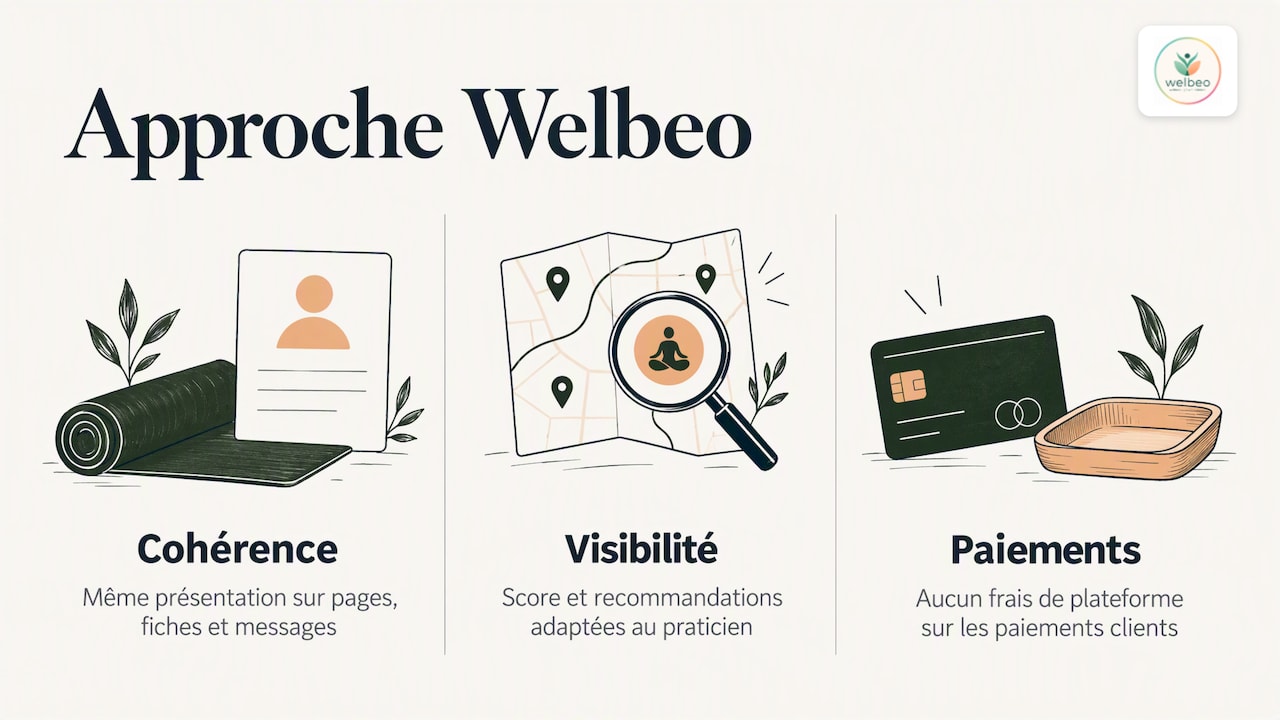
Welbeo helps wellness practitioners explain their services and provide booking options. Its digital-presence readiness score is a checklist-style measure of online-profile completeness, not a live Google ranking score. Where Search Console data is connected, observed clicks and impressions can be reviewed separately from bookings.
Explore the Welbeo yoga directory and the professional offering for current features. Verify pricing and availability on the Welbeo pricing page, rather than relying on a fixed plan price in an article that may age.
Examples from other wellness practices
Yoga teachers can also learn from the way other professionals communicate services on their own websites. For instance, Minsana Massage presents a local massage practice, while Stéphanie Avédissian and Laure Manlot illustrate independently branded practitioner websites.
These examples are not yoga studios, nor claims that their SEO results or booking performance have been verified. They simply demonstrate ways to structure useful professional information.
A practical 30-day plan
Week 1 — Clarify: Identify teaching styles, levels, actual venues and service descriptions. Check public contact details.
Week 2 — Improve pages: Update class descriptions, accessible navigation and accurate Google business information if eligible.
Week 3 — Simplify booking: Confirm timetable, reservation links, cancellation terms and privacy notices. Test with a phone.
Week 4 — Publish and measure: Publish one helpful article, link it to a relevant class and review search queries, website clicks and bookings as distinct indicators.
Repeat the review monthly. SEO may take weeks or months to show meaningful results.
Common mistakes
Avoid targeting only the broad word “yoga”, creating duplicate location pages, hiding prices and schedules, neglecting mobile usability, making unsupported therapeutic claims or automatically attributing every booking to Google.
Frequently asked questions
How quickly will local yoga SEO work?
There is no guaranteed timeframe. Some local information changes may become visible quickly, while meaningful search trends often need several weeks or months.
Does an independent yoga instructor need a website?
A website offers control over class explanations, locations and booking. An appropriate business profile and professional directory can also help discovery, but they serve different purposes.
What keywords work best for a yoga studio?
Choose combinations of real style, experience level, city or venue and class format. Focus on what prospective students actually need.
Does GDPR apply to yoga teachers?
Yes, when they process personal information. The applicable requirements depend on the purposes, legal basis, data and providers involved.